By Sumaila Ogbaje
The Nigerian Army has called for smarter, adaptive and forward-looking leadership among its senior officers to effectively respond to evolving security threats, technological disruptions and changing global geopolitical realities.
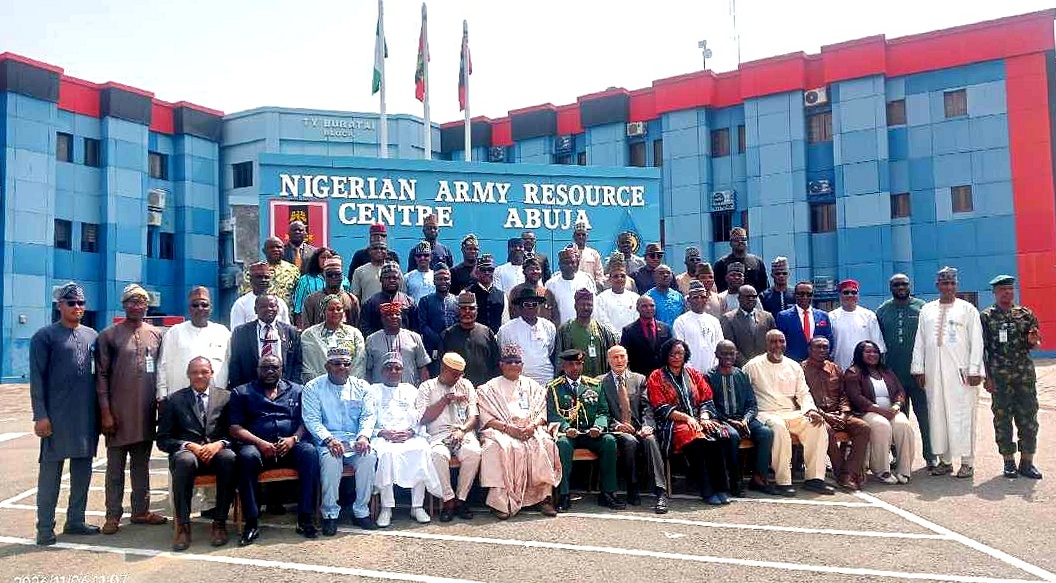
The Chief of Training (Army), Maj.-Gen. Valentine Okoro, made the call at the graduation ceremony of participants of the 2026 Senior Executive Strategic Leadership Programme, Phase II, organised by the Nigerian Army Resource Centre (NARC) in Abuja.
Okoro was represented by Maj.-Gen. Umar Yusuf, Coordinator, Nigerian Military Training Support and Assistance Team, Army Headquarters, Department of Army Training.
He said contemporary security challenges required more than physical courage and tactical brilliance, stressing the need for strategic depth, clarity of thought and adaptive leadership.
He explained that the Nigerian army was currently engaged in multiple operations across the country, confronting terrorism, insurgency, banditry, separatist agitations and other asymmetric threats.
“The current security realities confronting our nation demand more than physical courage and tactical brilliance. They require strategic depth, clarity of thought and adaptive leadership.
“Navigating the complex security environment requires officers who can think critically, plan comprehensively and act decisively,” he said.
Okoro said the programme was deliberately designed to sharpen strategic leadership skills, enhance policy understanding and deepen global perspectives among senior officers of the Nigerian army.
He also said that the initiative aligned with the command philosophy of the Chief of Army Staff, Lt.-Gen. Waidi Shaibu, to transform the Nigerian army into a more professional, adaptable, combat-ready and resilient force.
He urged the graduating officers to translate the knowledge acquired into practical leadership outcomes in the field, at headquarters and wherever duty called.
“The knowledge acquired must be translated into actionable leadership in the field, at headquarters and wherever duty calls.
“I therefore urge you to deploy the knowledge and experience gained from this course, not only to mitigate the security challenges confronting Nigeria but also to align yourselves with the changes taking place across the world,” he said.
The chief of training noted that the rapidly changing global environment made it difficult to predict where the next crisis might emerge.
He urged the officers to remain intellectually prepared and adaptable to emerging national, regional and international security developments.
Earlier, the Director-General of NARC, retired Maj.-Gen. James Myam, said the programme was designed to expose senior military leaders and critical stakeholders from ministries, departments and agencies to contemporary geostrategic paradigms.
Myam expressed satisfaction that the participants had acquired new adaptive leadership and learning skills to navigate the complexities of Nigeria’s regional and global security environment.
He said the partnership with the African Leadership Centre of King’s College London, was part of the centre’s efforts to strengthen strategic leadership and institutional capacity.
“The programme’s theme, “Adaptive Leadership and National Security in Nigeria: Coping with Artificial Intelligence and Social Vulnerabilities in an Era of Changing Global Norms and Geopolitical Competition,” is carefully selected to reflect developments in the global security environment,” he said.
He urged the graduating officers to deploy the knowledge acquired in managing complex challenges and justify the investment made in their professional development.
“I urge you to always be good ambassadors of the Nigerian Army Resource Centre and the King’s College London programme,” he said.
Myam commended the Chief of Army Staff and Chairman, Board of Trustees of the centre, Lt.-Gen. Waidi Shaibu, for his interest and unwavering support for its activities.
He also appreciated members of the board of trustees for their guidance, while commending the facilitators and resource persons from King’s College London for delivering insightful lectures, specialised modules and thought-provoking case studies.
In his remarks, the Team Lead from King’s College London, Prof. Randolph Charles Kent, said the programme provided an opportunity for participants and facilitators to jointly examine emerging global challenges and opportunities.
Kent said discussions covered changes in the multilateral system, the profound consequences of technological advancement, new forms of conflict and emerging institutional structures.
He said the programme also explored opportunities presented by scientific innovations, including new approaches to food production, alternative sources of water and renewable energy.
According to him, the participants examined adaptive leadership from individual and societal perspectives to institutional, regional and global levels.
“We learnt from you, and we hope you also learnt from us. Together we explored how leaders can anticipate potential risks and opportunities, monitor emerging developments, adapt to changing circumstances and ultimately respond to challenges effectively,” he said.
Kent described collective learning and engagement as critical elements of adaptive leadership.
He expressed confidence that the partnership had enabled participants and facilitators to develop shared perspectives on contemporary challenges and future opportunities.
He thanked the Nigerian army resource centre and the participants for their commitment and active engagement, which he said contributed to the success of the programme.
The senior executive strategic leadership programme, phase II, commenced on Nov. 2, 2026, at the Nigerian army resource centre in collaboration with the African leadership centre of king’s college, London.
The programme brought together senior military officers and other critical stakeholders to examine adaptive leadership, national security, artificial intelligence, social vulnerabilities and changing global geopolitical dynamics.
The graduation marked another milestone in the Nigerian army’s efforts to strengthen professional military education, strategic thinking and leadership capacity for effective responses to contemporary security challenges.(NAN)