Since Colleen’s adverse claim emerged in 2023, the dispute has escalated into EFCC investigations, prosecution, forfeiture proceedings and occupation of Rebecca’s residence. Now, despite a Federal High Court order directing the parties to maintain status quo ante bellum, Rebecca says she remains without water, electricity or cooking gas.
No court has finally determined who owns Plot 4022, Guzape, Abuja.
No final judgment has declared Colleen Mero Yesufu the lawful owner.
No final judgment has extinguished the interest asserted by Mrs Rebecca Omokamo Godwin-Isaac.
Yet the Economic and Financial Crimes Commission, EFCC, is asking the Federal High Court to forfeit the disputed property to the “for the benefit” of private complainants, including Colleen Mero Yesufu.
While ownership remains unresolved, Rebecca says she has been left inside the residence without water, electricity or cooking gas.
She cannot cook normally.
She cannot preserve food.
She cannot bathe properly.
Food in her refrigerator and freezer has spoiled.
Her home has become increasingly unhygienic and difficult to inhabit.
This is happening despite a Federal High Court order directing all parties to maintain status quo ante bellum, meaning the position that existed before the confrontation.
EFCC’s Own Filing Reveals the Intended Private Benefit
This is not speculation.
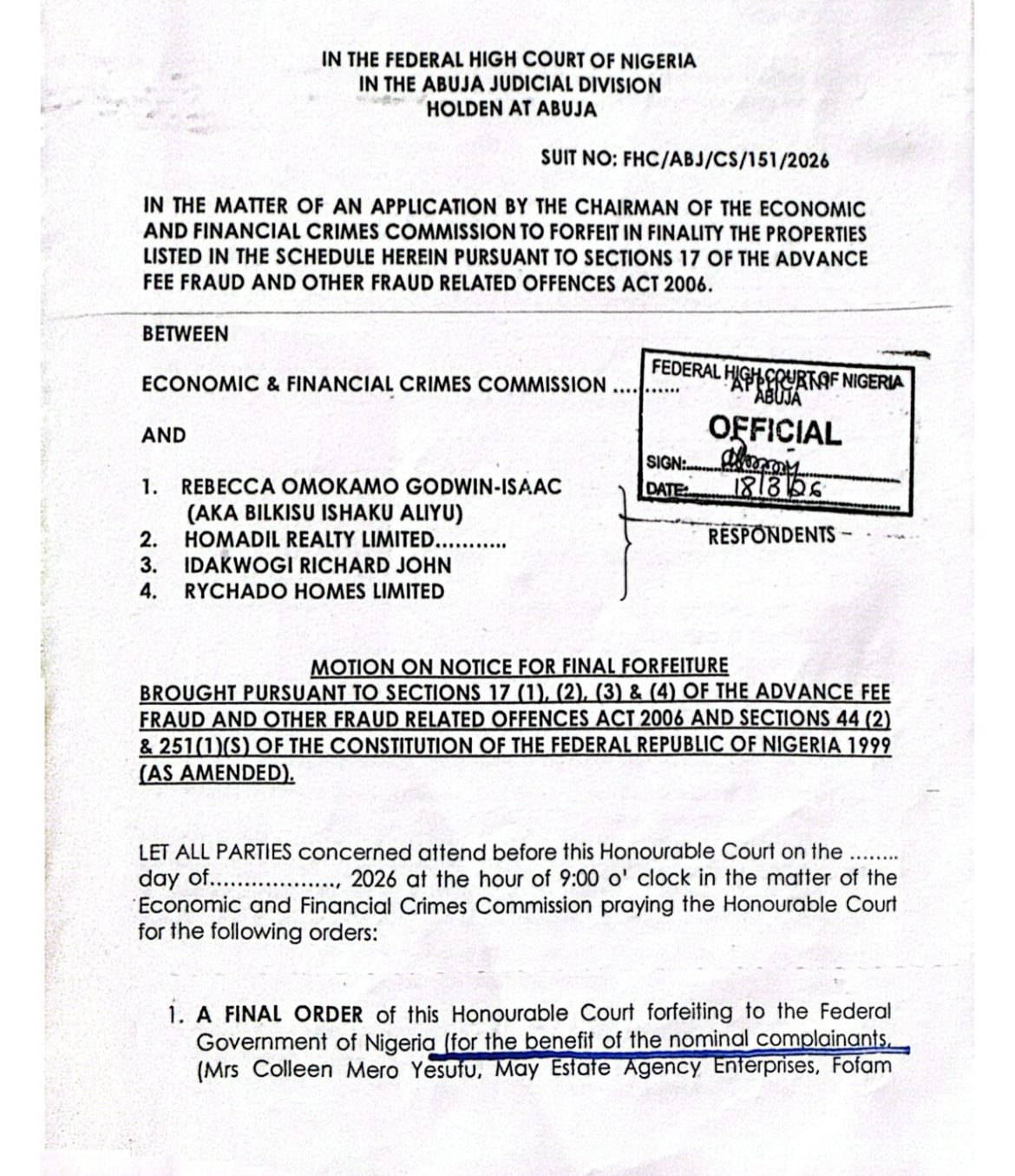
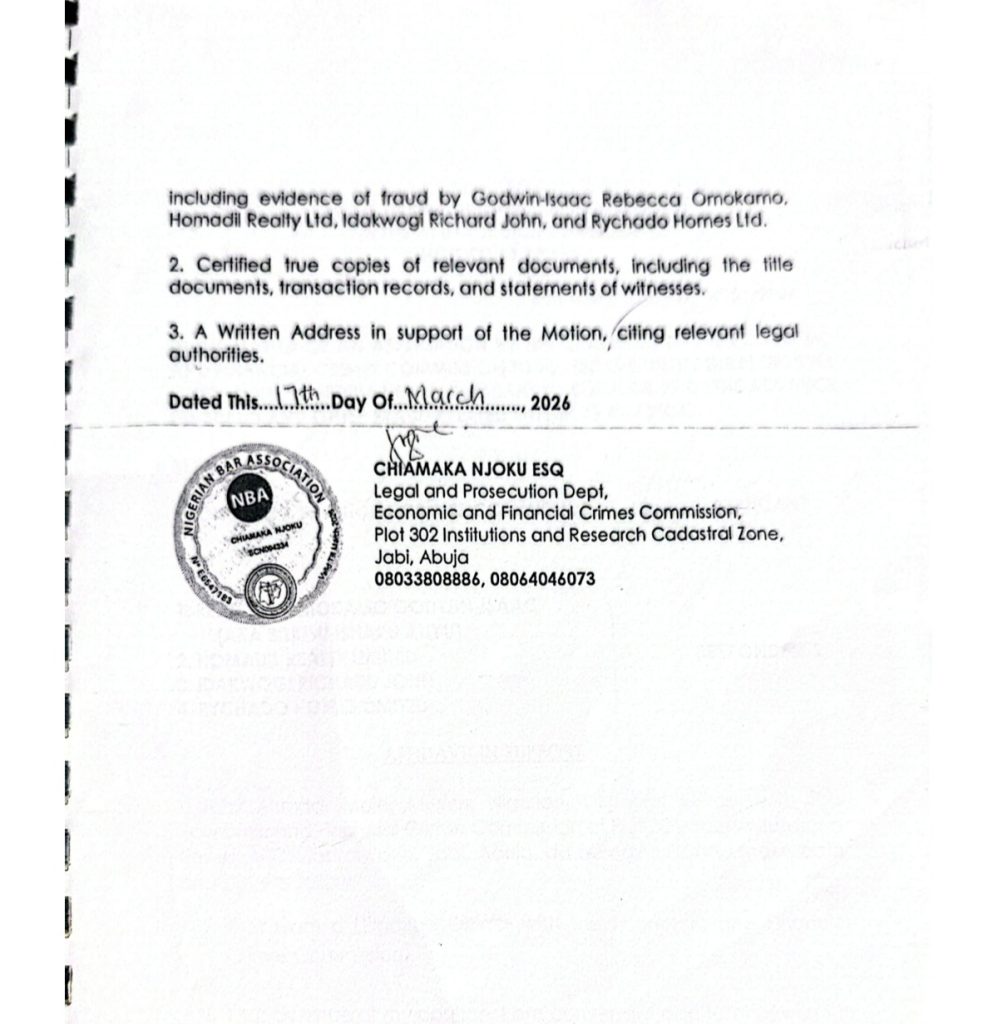
It is contained in EFCC’s Motion on Notice for Final Forfeiture in Suit No. FHC/ABJ/CS/151/2026.
On page one, EFCC asks the Federal High Court for:
“A final order of this Honourable Court forfeiting for the benefit of the nominal complainants…”
The Commission names Mrs Colleen Mero Yesufu, May Estate Agency Enterprises, Fofam Nigeria Ltd and Adamu Ayeloda Nigeria Enterprises as the nominal complainants.
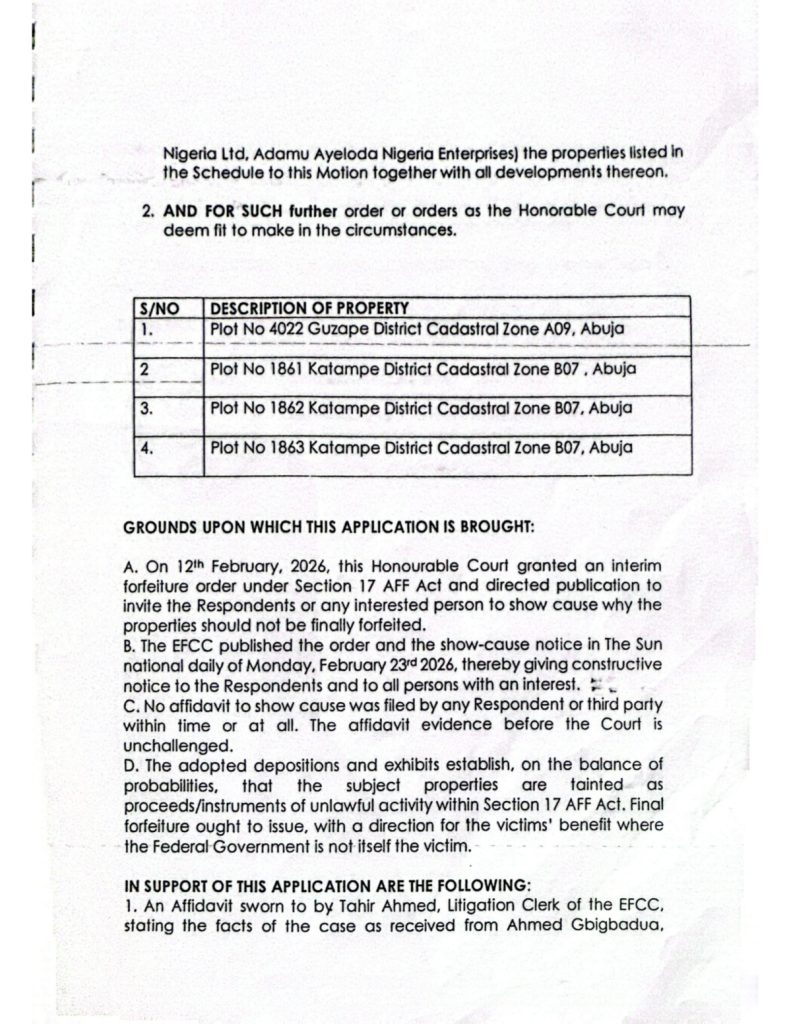
On page two, the first property listed for forfeiture is:
“Plot No. 4022 Guzape District Cadastral Zone A09, Abuja.”
EFCC further argues that final forfeiture should issue:
“With a direction for the victims’ benefit where the Federal Government is not itself the victim.”
Those are EFCC’s own words.
The Federal Government is not described as the victim.
Private complainants are named as the intended beneficiaries.
Colleen Mero Yesufu is one of them.
Yet no court has declared her the owner of Plot 4022.
A Complainant Is Not an Owner
Colleen asserts a claim to Plot 4022.
Rebecca also asserts an interest in the property.
The court must examine the original allocation, chain of title, payments, transfers, possession, development and authenticity of the documents relied upon by both sides.
Until that process is completed, Colleen remains a claimant, not a court-declared owner.
Calling someone a complainant does not confer title.
Describing someone as a victim does not transfer land.
A complaint is not a judgment.
An allegation is not ownership.
An EFCC investigation is not a conveyance.
The power of the Federal Government must not be used to create the practical result of a land judgment that no court has delivered.
A Troubling Pattern Since 2023
Since that claim emerged, the dispute has escalated beyond an ordinary contest over title.
It has developed into EFCC investigations, criminal allegations, forfeiture proceedings and, most recently, EFCC’s physical intervention at the residence.
Rebecca’s position is that EFCC has treated Colleen’s claim as superior even though her ownership has not been conclusively established by a court and her documents remain subject to judicial scrutiny.
Now EFCC’s own motion says the forfeiture is being pursued for the benefit of named private complainants, including Colleen.
That sequence creates an appearance too serious to ignore.
It creates the appearance that the coercive power of a federal agency is being deployed in a manner that advances one private claimant’s position in an unresolved land dispute.
It does not, by itself, prove a secret agreement or criminal collaboration.
But it demands an independent investigation into the entire relationship between the complaints made, the actions taken by EFCC and the private benefit expressly contemplated in the forfeiture motion.
EFCC must disclose why Colleen was treated as a victim before any court declared her the owner.
Forfeiture Must Not Become Private Conveyancing
EFCC relies on section 17 of the Advance Fee Fraud and Other Fraud Related Offences Act.
That section permits forfeiture where a court is reasonably satisfied that property is unclaimed or represents proceeds of unlawful activity. It also requires notice and an opportunity for persons claiming an interest to show cause.
But section 17 repeatedly states that property is forfeited to the Federal Government of Nigeria.
It does not determine the private ownership of disputed land.
It does not automatically convert a complainant into the owner.
It does not permit forfeiture to become a shortcut around a pending title dispute.
Forfeiture is one legal process.
Compensation is another.
Restitution is another.
Determination of land ownership is another.
These separate processes must not be collapsed into one procedure that manufactures a private winner before ownership has been judicially determined.
If EFCC says Plot 4022 is connected to fraud, it must identify the alleged unlawful activity and prove the connection between that activity and the property.
It cannot simply adopt one claimant’s account, describe that claimant as a victim and seek an outcome expressly intended to benefit her before the court determines title.
The Court Ordered Status Quo Ante Bellum
On 3 July 2026, the Federal High Court ordered the parties to maintain status quo ante bellum pending the hearing and determination of the motion.
Rebecca says the position before EFCC’s intervention on 29 June was clear.
She had water.
She had electricity.
She had cooking gas.
She could cook, preserve food and bathe.
She occupied the residence peacefully.
EFCC operatives were not stationed there.
Yet after the Court made its order, Rebecca says those conditions were not restored.
The operatives remained.
The water remained disconnected.
The electricity remained disconnected.
The cooking gas remained disconnected.
A formal request to Force Legal Services stated that EFCC operatives remained at the property after the order and that the occupants had not been restored to the position that existed before the occupation. It described the situation as an immediate threat to life, health and safety.
A court order is not obeyed merely because lawyers acknowledge it in legal papers.
It is obeyed when conduct on the ground reflects what the Court directed.
Rebecca Is a Human Being, Not Just a Respondent
Sixteen days without water is not property preservation.
Sixteen days without electricity is not investigation.
Sixteen days without cooking gas is not justice.
Leaving a woman unable to bathe does not prove fraud.
Allowing her food to spoil does not establish title.
Keeping her residence in darkness does not protect evidence.
Making her home unbearable cannot determine who owns Plot 4022.
Rebecca is not merely a name printed on the first page of an EFCC motion.
She is a woman living inside the disputed property.
She needs water for drinking, bathing and sanitation.
She needs electricity for lighting, refrigeration, communication and security.
She needs cooking gas to prepare food.
The Constitution protects human dignity and recognises the right of citizens to acquire and own immovable property, subject to lawful judicial processes. (placng.org)
Nothing in EFCC’s forfeiture motion authorises darkness.
Nothing authorises hunger.
Nothing authorises deprivation of water.
Nothing authorises the destruction of human dignity.
EFCC Must Answer
EFCC must explain which complainant is connected to Plot 4022.
It must explain what “for the benefit of the nominal complainants” means in practical terms.
Would the proceeds be paid to Colleen or another complainant?
Could the property itself eventually be handed to a private claimant?
Under what law?
After what determination of ownership?
It must also explain why Rebecca’s utilities and peaceful living conditions have not been restored after the Federal High Court ordered the parties to maintain the pre-dispute position.
Let the Court Determine Ownership
Rebecca is not asking to be placed above the law.
She is not asking that credible allegations be ignored.
She is asking that allegations be proved before they are treated as judgments.
She is asking that ownership be determined before federal power is used for the benefit of private complainants.
She is asking that the Federal High Court’s order be respected in practice.
She is asking for water.
She is asking for electricity.
She is asking for cooking gas.
She is asking to cook, bathe, eat and live safely while the courts determine the truth.
No private claimant should obtain through federal pressure what that claimant has not obtained through a final judgment.
No anti-corruption agency should appear to become an instrument for securing disputed private property.
No forfeiture proceeding should become private conveyancing.
And no woman should be left in darkness and deprivation while another claimant is named among those intended to benefit from the forfeiture of her residence.
The public is entitled to ask:
WHY IS EFCC SEEKING TO FORFEIT DISPUTED LAND FOR THE BENEFIT OF COLLEEN MERO YESUFU AND OTHER PRIVATE COMPLAINANTS BEFORE ANY COURT HAS DETERMINED WHO OWNS IT?
Restore Rebecca’s water.
Restore her electricity.
Restore her cooking gas.
Respect her dignity.
Respect the Federal High Court.
Investigate the pattern since 2023.
Let the evidence be tested.
Let the Court determine ownership.
Not darkness.
Not deprivation.
Not institutional pressure.
Ownership must be determined first.