
By Franca Ofili
The International Committee of the Red Cross (ICRC) says its Global Initiative on International Humanitarian Law (IHL) aims to renew political commitment and strengthen practical engagement on IHL implementation globally.
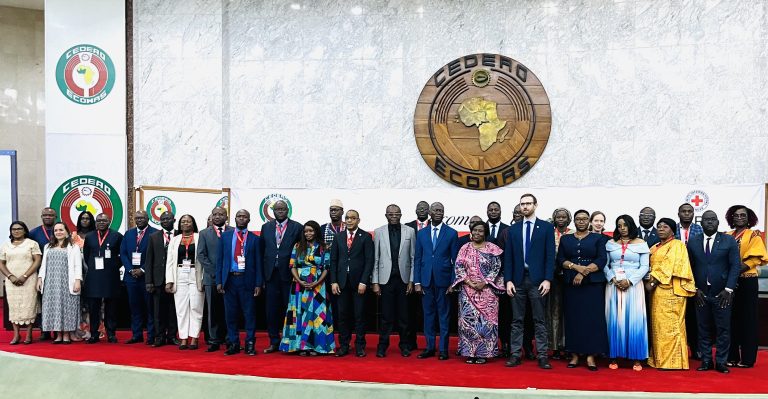
Mr James Mathews, Deputy Head of the ICRC Delegation in Abuja, said this on Tuesday during the 21st Annual ECOWAS–ICRC Review Meeting on IHL implementation in West Africa.
The meeting’s theme focuses on the final phase of the ECOWAS IHL Action Plan (2019–2026), protection of healthcare during conflict, national IHL committees, and the ICRC’s global initiative.
Mathews said that as the ECOWAS IHL Action Plan entered its final phase, it was crucial to assess achievements made and the persistent challenges facing IHL implementation across the region.
“For over two decades, our collaboration has provided a unique platform for peer exchange, technical reflection, and collective action in translating IHL from theory into meaningful domestic implementation,” Mathews said.
He emphasised that protecting hospitals and health workers during armed conflicts was both a legal obligation and humanitarian necessity, directly impacting patients, medical staff, and entire communities in crisis zones.
Mathews added that strengthening national IHL committees remained critical for ensuring sustainability, technical expertise, and national ownership of humanitarian law implementation in each ECOWAS member state.
He said the ICRC initiative was launched one year ago with support from Brazil, China, France, Jordan, Kazakhstan, South Africa, and the ICRC to generate actionable global recommendations on IHL.
“The voices of ECOWAS states will shape global outcomes. Five states already support the initiative, with three co-chairing key workstreams and others actively participating in ongoing consultations,” Mathews noted.
He encouraged other ECOWAS countries to officially join the initiative, contributing their experiences and ideas to ensure IHL remained relevant, respected, and a framework for mitigating conflict and suffering.
Mathews affirmed ICRC’s continued support, technical, operational, and strategic, through its enduring partnership with ECOWAS and its member states for stronger humanitarian law enforcement and conflict prevention mechanisms.
Mr Ousmane Diallo, Director of Research and Documentation, who represented the ECOWAS Court President, acknowledged the ICRC’s critical role in promoting respect for and implementation of humanitarian law.
Diallo said while the court’s mandate did not include IHL interpretation, it supported ICRC goals through justice promotion, human rights protection, and advocacy against violations in member states.
“The court has collaborated with ICRC through seminars and workshops, helping to align regional legal frameworks with IHL principles and improve judicial responses to conflict and humanitarian crises,” he said.
He noted that the court’s work complemented ongoing efforts by the ICRC and ECOWAS Commission to protect human rights, prevent conflict, and promote peace within the ECOWAS region.
Mr Nnanna Ibom, of the International and Comparative Law Department, representing Lateef Fagbemi, the Minister of Justice and Attorney General of the Federation, said the meeting offered a chance to assess progress, address challenges, and deepen collaboration to better safeguard human life and dignity.
Fagbemi stated that the ECOWAS Action Plan on IHL demonstrated shared dedication to humanitarian principles, civilian protection, and promoting peace and stability throughout the West African region.
Dr Sintiki Ugbe, ECOWAS Director of Humanitarian and Social Affairs, said the meeting reflected a transitional moment for the Commission’s work on IHL implementation across its member states.
She said outcomes included strengthening IHL expertise, sharing successful practices, boosting implementation capacity, and enhancing cross-border collaboration through improved action plans and coordinated policy mechanisms.
Ugbe noted that discussions would focus on protecting hospitals and healthcare, while developing a consolidated progress report on the 2019–2026 IHL Plan and actionable steps for 2024–2028 pledges.
She explained that the platform would also address ECOWAS-related activities in prevention, resolution, and peacekeeping, anchored in human rights and humanitarian protection principles of the ECOWAS revised treaty.
“One core principle of our treaty is protecting fundamental human rights and freedoms. That is why ECOWAS prioritises the annual meeting,” Ugbe said.
NEWS AGENCY OF NIGERIA