By Joan Nwagwu
The Federal Government and the Organisation of Trade Unions of West Africa (OTUWA) have called for expanded social protection coverage, particularly for workers in the informal economy across West Africa.
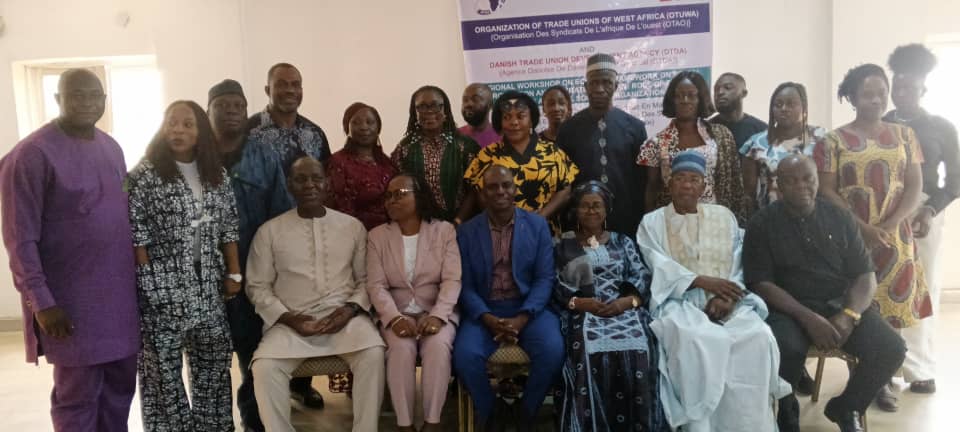
The call was made on Monday at the opening of a two-day regional workshop organised by OTUWA in collaboration with the Danish Trade Union Development Agency (DTDA) in Abuja.
The Minister of Labour and Employment, Dr Muhammad Dingyadi, said millions of workers remained excluded from formal social security systems despite their contributions to economic growth, agriculture, trade and other productive activities.
Dingyadi, represented by Mr Aper Ifi, Assistant Director, Social Security in the ministry, described social protection as fundamental to safeguarding human dignity, reducing poverty and promoting equality.
According to him, expanding social protection coverage is essential to ensuring that workers, irrespective of their employment status, have access to adequate social security benefits.
“It helps in reducing poverty, promoting equality and ensuring that no worker is left behind,” the minister said.
He urged governments, trade unions, employers and development partners to move beyond policy discussions and take practical steps towards making social protection accessible, affordable, inclusive and sustainable.
Dingyadi also called on trade unions to champion universal social protection by organising informal economy workers and ensuring that vulnerable groups were adequately represented in national and regional policy decisions.
He expressed optimism that the workshop would produce practical recommendations, strengthen regional cooperation and promote the portability of social security benefits where applicable.
The Acting President of OTUWA, Mrs Sophie Kourouma, said social protection coverage in West Africa stood at 16 per cent, below the African average of 19.1 per cent.
“West Africa is lagging behind the rest of the regions on our continent in social protection coverage,” Kourouma said.
She described the ECOWAS Social Protection Framework as an important advancement in regional social policy, designed to guide member states in strengthening and expanding their social protection systems.
Kourouma said the workshop would identify strategic entry points for trade unions and civil society organisations to participate effectively in implementing, monitoring and evaluating the framework.
She added that participants would examine the relationship between social protection, climate change, just transition and gender equality while developing advocacy strategies suited to the needs of the sub-region.
According to her, presentations on the ECOWAS framework and the International Labour Organisation’s Global Social Protection Report would support the development of effective national action plans.
Also speaking, Ms Lilliane Napoe, DTDA’s representative in West Africa, urged trade unions to intensify efforts to extend social protection benefits to workers in the informal economy.
Napoe described the launch of the ECOWAS Social Protection Framework and Operational Plan (2024–2028) as a significant milestone in regional social policy, providing a roadmap for expanding coverage, improving access to essential services and promoting social inclusion.
She expressed concern that only about 16 per cent of West Africans enjoyed at least one social protection benefit, while public spending on social protection across the region averaged less than one per cent of Gross Domestic Product (GDP).
“These figures are not mere statistics; they represent millions of workers, particularly those in the informal economy, whose livelihoods, dignity and security remain precariously unprotected,” Napoe said.
She noted that the informal economy remained central to West Africa’s labour market, yet many workers continued to lack adequate labour rights, legal protection and social safety nets.
Napoe stressed the need for stronger collaboration among governments, trade unions, civil society organisations and development partners to address the challenges preventing informal economy workers from accessing social protection.