By Justina Auta
The Federal Government has reaffirmed its commitment to strengthening sustainable inclusive family planning services for Persons With Disabilities (PWDs) to advance access to equitable reproductive health initiatives nationwide.
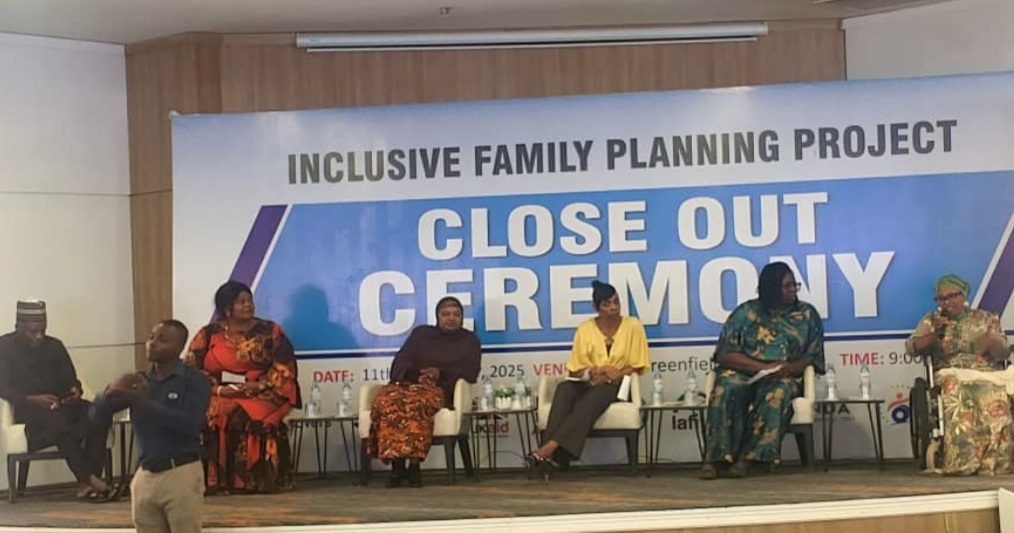
The government made the commitment at the close-out ceremony of the five-year Inclusive Family Planning (IFPLAN) project on Thursday in Abuja.
The IFPLAN project is funded by UK Aid and implemented by a consortium led by Sightsavers and other implementing partners.
The partners include BBC Media Action, the Programme for Evidence to Inform Disability Action, the Network of Women with Disabilities, and the Joint National Association of Persons with Disabilities.
The project was designed to increase knowledge and uptake of family planning among PWD, while strengthening service providers and disability organisations to support an inclusive health system.
Over its implementation period, the project reached 1,912 PWD people with disabilities in 18 communities with social and behaviour-change interventions.
The project provided family planning information to 544,759 people with disabilities through radio, digital platforms and community engagement.
It also reached over three million PWDs with stigma-reduction messages; conducted accessibility audits in 24 health facilities; supported 23 facilities with accessibility upgrades; and trained 1,500 healthcare providers, among others.
Dr Salma Ibrahim-Anas, Special Adviser to the President on Health, said that the initiative was a model for disability inclusion and a key contributor to the Federal Government’s “Renewed Health Agenda”.
Ibrahim-Anas, represented by Dr Fatima Jibrilla, commended the project’s partners for what she described as a powerful demonstration of inclusive development.
“The main achievement of the IFPLAN project is not just a technical milestone, it is proof of inclusive development and a great example of what we can accomplish when we commit to leaving no one behind.
“This project’s success aligns perfectly with the Renewed Health Agenda of this administration.
“Our goal is clear; it is to ensure every Nigerian, regardless of socioeconomic status, geographic location, or physical ability, has equal access to healthcare services,” she said.
According cent to her, the Renewed Health Agenda builds the health of women and girls, not merely as a clinical issue, but as a direct practice for national development and economic prosperity.
“Family planning in this context is not seen as an afterthought; it is a critical, prospective pillar of our public health strategy.
“We acknowledge the complex needs of modern contraceptive use, and we must actively expand our coverage based on what we know is achievable.
“This is by getting to know, and ensuring that we meet all the contraceptive needs of women, regardless of their socioeconomic and ability status.
“The IFPLAN project has offered us invaluable lessons, proving that inclusive and tailored approaches are necessary,” she said.
She stressed the need to dismantle barriers to access by addressing the physical, attitudinal, and communication barriers that prevent persons with disabilities from accessing essential services.
“The success in Kaduna State shows that targeted training of health workers and the provision of accessible information can bridge this gap.
“We must also institutionalise value by ensuring that sustainability plans being discussed today move beyond paper,” she said.
She highlighted the need for sustainability plans to guide the government’s transition into a long-term effort to scale the project’s lessons nationwide.
Prof. Joy Shuaibu, Country Director of Sightsavers Nigeria, emphasised that the IFPLAN project proved that when inclusion is intentional, it creates real impact for women and girls with disabilities.
Prof. Shuaibu highlighted that empowering healthcare workers with the right knowledge was one of the most sustainable investments of the project.
“When you empower someone with education and knowledge, it stays with them forever. So, we wanted to make sure that the healthcare providers are comfortable providing services for persons with disabilities.
“One of the things we did on this project was to provide knowledge to ensure that they know what to do,” she eaid.
She also said that the next phase must focus on institutionalising disability inclusion in health policies and ensuring that persons with disabilities remain actively involved in shaping future programmes.
“What we have tried to do is to demonstrate to you that inclusive programming, especially in terms of sexual and reproductive healthcare, is possible.
“I want to guarantee you that if you need any support of any kind in terms of technical support, please come to us, we will be willing to share.
“Ultimately, we want to create a country, a society where persons with disabilities have equal access to healthcare, education and livelihood,” she said.
Also, Mohammed Isa, Senior Special Assistant to the President on Special Needs and Equal Opportunities, described the project as a transformational intervention that expanded reproductive health access for women and girls with disabilities across Kaduna State.
Isa was represented by Lanre Oloyede, Director of Media and Communications, Office of the Senior Special Assistant to the President on Special Needs and Equal Opportunities.
He emphasised the need for stronger government coordination in future disability-focused projects.
He reaffirmed the government’s readiness to collaborate more strategically with development partners as efforts shift toward expanding disability-inclusive family planning nationwide.
“Let us continue to push for a Nigeria where no woman, no girl, and no person with a disability is denied the right to make informed choices about their own body and their own future,” he said.
Hajiya Umma Ahmed, Kaduna state Commissioner for Health, said the project has brought hope and tangible progress to countless families by ensuring that PWDs have equitable access to family planning services.
She said that the impact of this project would remain a cornerstone in the collective journey toward Universal Health Coverage.
“in Kaduna State, we firmly believe that no citizen should be left behind, regardless of ability or circumstances.
“Through increased budgetary allocations to health, we have been able to sustain the 15 per cent accrued during our budget period for the health sector.
“For us, there is no close-out. We have made provision in the 2026 budget, so there is a budget line for this project,” she said.
The commissioner said that it showed the commitment of the Kaduna State government to sustain inclusion in state, and the support of disability inclusion policies.
“This will make health services accessible to all, strengthen family planning initiatives, and recognizing their role in reducing maternal mortality and empowering families.” (NAN)