By Sumaila Ogbaje
The Chief of Army Staff (COAS), Lt.-Gen. Waidi Shaibu, says success in counter-terrorism operations was no longer determined by single-service efforts but by joint, multi-agency collaboration and coordinated action.
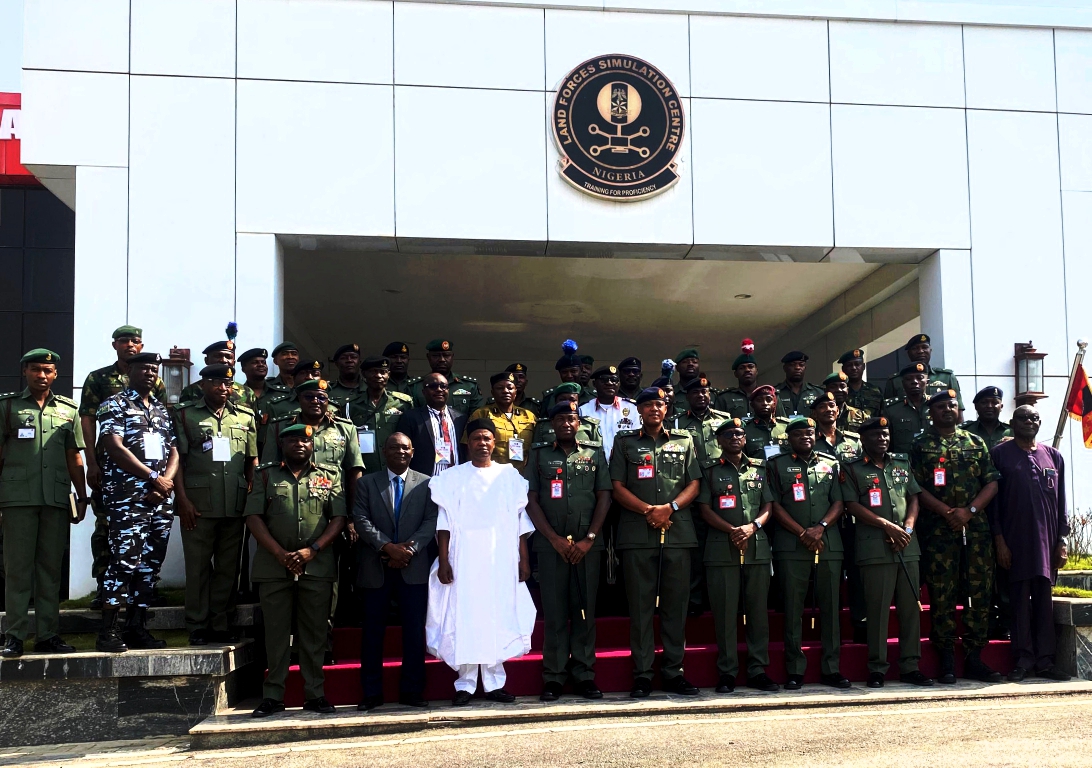
Shaibu said this at the opening of the 2026 Simulating Training workshop, organised by the Land Forces Simulation Centre (LFSC), on Tuesday in Abuja.
He said that the training workshop aimed at enhance troops’ adaptability and operational readiness.
The News Agency of Nigeria (NAN) reports that the workshop has as theme ”Leveraging Joint and Multiagency Capabilities to Strengthen Troops’ Adaptability and Resilience during Counter Terrorism and Counter Insurgency Operations”.
Represented by the Commander, Nigerian Army Cyber Warfare Command (NACWC), Maj.-Gen. Kennedy Osemwegie, he also said that the workshop would allow troops formulate and test operational plans without logistical constraints or fatigue.
”It is a strategic asset for realistic, technology-driven, and cost-effective training,” he said.
The COAS urged participants to engage actively, challenge assumptions, and deepen understanding of intelligence fusion, civil-military cooperation, and inter-agency coordination to ensure mission success.
He said the workshop aligned with the Nigerian Army’s transformation drive to build a professional, adaptable and combat-ready force capable of operating effectively in joint and multi-agency environments.
He thanked President Bola Tinubu, for his support and reaffirmed the loyalty of the Nigerian army to defending the nation’s sovereignty.
Earlier, the Director-General of LFSC, Maj.-Gen. Mohammed Wabili, said the training workshop was timely given the complex and evolving security threats facing the country.
Wabili said that addressing such threats required not only tactical proficiency but also strong collaboration among the Armed Forces, security agencies and other stakeholders.
”The Nigerian Army-led counter-terrorism and counter-insurgency operations demand synergy, interoperability and a shared understanding of operational challenges.
”It is through such collaborative efforts that we can strengthen the adaptability and resilience of our troops in the face of evolving threats,” he said.
He added that the centre remained committed to providing a modern platform for capacity development through simulation-based training.
According to him, simulation enables commanders and troops to rehearse operational scenarios, enhance decision-making and test operational concepts in a controlled but realistic environment.
He urged participants to actively engage in discussions and share experiences that would enrich the outcomes of the workshop. (NAN)