By Sumaila Ogbaje, News Agency of Nigeria (NAN)
In a security environment increasingly shaped by asymmetric threats, Nigeria’s air power capability has emerged as a decisive element in the country’s fight against terrorism and violent criminality, with the Nigerian Air Force (NAF) playing a central role in operational successes recorded in 2025.
From the insurgency-ravaged North-East to bandit-infested forests of the North-West and parts of the North-Central, air assets have provided speed, reach and precision, reshaping the dynamics of joint military operations and strengthening national security outcomes.
Security experts say the effectiveness of air power in 2025 reflects sustained investment in platforms, personnel training, intelligence integration and inter-service cooperation, all of which have enhanced the armed forces’ ability to respond rapidly to evolving threats.
Nigeria’s security challenges in 2025 remained complex and multi-dimensional, ranging from terrorism and banditry to kidnapping, separatist violence and transnational criminal activities.
These threats, often characterised by mobility, concealment within civilian populations and exploitation of difficult terrain, have reinforced the relevance of air power as a strategic enabler.
According to defence analysts, air operations provide situational awareness and rapid strike capability that ground forces alone cannot achieve, particularly in vast, forested or inaccessible areas.
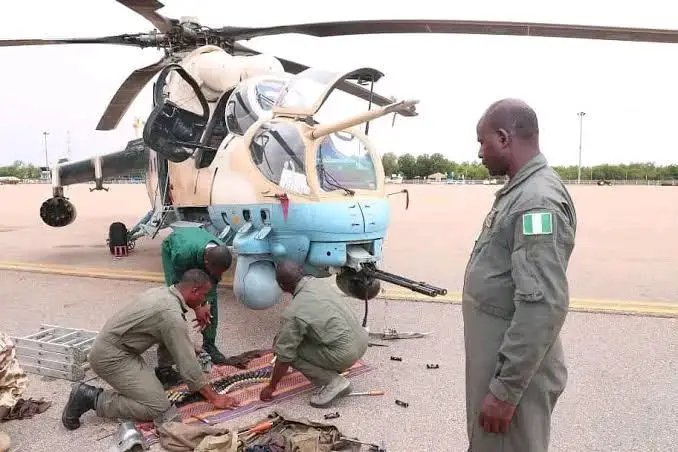
Against this backdrop, the Nigerian Air Force sustained a high operational tempo throughout the year, deploying fighter aircraft, attack helicopters, transport platforms and unmanned aerial vehicles across multiple theatres.
The Chief of Air Staff, Air Marshal Sunday Aneke, has consistently underscored the importance of air power as a force multiplier in contemporary warfare.
Aneke noted that air assets enable the Armed Forces to shape the battlespace, disrupt enemy logistics and deny hostile elements freedom of movement, thereby reducing risks to troops on the ground.
He highlighted precision engagements, tactical mobility, and Intelligence, Surveillance, and Reconnaissance (ISR) as key strengths of air power that have significantly strengthened joint operations across the country.
“We must fly smarter and strike harder not only to neutralise threats but also to protect the lives and properties of Nigerians.
“Every mission must reflect professionalism, purpose, and patriotism.
“Our operations must be intelligence-led, coordinated, and focused. We will continue to work closely with the sister services and other security agencies to ensure a united front in the fight against terrorism and criminality,” he said.
In 2025, NAF aircraft were actively engaged in operations such as Operation HADIN KAI, Operation FANSAN YAMMA, Operation ENDURING PEACE and Operation WHIRL STROKE, providing close air support and conducting interdiction missions.
Military assessments indicate that sustained air strikes and reconnaissance operations degraded terrorist infrastructure, forced criminal elements to disperse and limited their capacity to conduct coordinated attacks.
A defining feature of NAF operations in 2025 was the expanded deployment of intelligence, surveillance and reconnaissance capabilities.
Persistent aerial surveillance enabled the identification of terrorist hideouts, tracking of movements and timely support to ground operations.
A look at the NAF’s operational engagement during the year under review indicates that the air components of the various operations executed a number of precision airstrikes, destroying several terrorists’ hideouts and logistics bases as well as killing scores of terrorists and bandits.
Following the recent U.S led precision airstrikes on identified terrorists’ encampment in Sokoto State on Dec. 25, the NAF successfully launched massive strikes on two key bandits’ enclaves in Zamfara on Dec. 29, eliminating dozens of the criminals.
In the North East, more than 80 terrorists have been eliminated including key commanders, in a series of ground-to-air coordinated onslaughts against the Boko Haram/ISWAP fighters between Dec. 25 and Dec. 29, in Banki and Bama axis of Borno.
According to the air chief, the integration of ISR platforms with strike assets shortened response times and improved operational accuracy.
Experts note that intelligence-driven air operations also help minimise collateral damage, a critical consideration in counter-terrorism campaigns that depend on civilian cooperation.
Operational successes recorded during the year were largely attributed to improved synergy among the Army, Navy and Air Force.
NAF aircraft provided close air support during clearance operations, troop insertions and extraction missions, often under challenging conditions.
The Minister of Defence, retired Gen. Christopher Musa, had during his stint as defence chief, repeatedly stressed that modern security threats require a unified approach, with each service contributing its unique strengths.
He said that improved coordination had enhanced operational tempo, protected personnel and allowed for rapid exploitation of intelligence.
“Air power remains central to the successes recorded across multiple theatres. The expectations placed on you are high because your elevated position requires clear vision, steady judgement, and an enduring sense of purpose.
“No Service can succeed in isolation. Air operations achieve full potential only when integrated with the Army, Navy, and all national security agencies,” he said.
Beyond combat operations, air mobility remained a critical contribution of the Nigerian Air Force to national security in 2025.
Transport aircraft and helicopters moved troops, equipment and supplies across operational areas, particularly in regions with limited road access.
This capability enabled quick reinforcement, casualty evacuation and redeployment in response to emerging threats.
Analysts describe air mobility as a key advantage in counter-terrorism operations, where speed and flexibility are often decisive.
In line with its constitutional mandate, the NAF also undertook humanitarian and civil support missions during the year.
Aircraft were deployed for medical evacuation, disaster response and delivery of relief materials to displaced populations, balancing combat operations with civil support, thereby strengthening public trust and national resilience.
Military Chiefs had always emphasised that military operations must always be guided by the protection of civilians and support to civil authorities.
Operational gains in 2025 were underpinned by ongoing modernisation and capacity development within the Air Force, such as fleet upgrades, improved maintenance practices and enhanced training programmes increased aircraft availability and mission readiness.
The CAS, Air Marshal Aneke, had stated that investment in human capacity remains central to sustaining air power effectiveness, stressing the importance of professionalism and discipline.
International partnerships and training exchanges with friendly nations further strengthened operational standards and technical expertise.
In spite of the notable achievements, security experts caution that air power alone cannot resolve Nigeria’s security challenges.
High operational demands place pressure on personnel and equipment, while adversaries continue to adapt their tactics.
Stakeholders have emphasised the need for a comprehensive approach that combines military action with governance, development and intelligence-led policing.
As Nigeria looks ahead, air power is expected to remain a cornerstone of national security strategy.
Analysts agree that continued investment in ISR, precision strike capability and joint operations will be critical to sustaining gains.
For many observers, the Nigerian Air Force’s performance in 2025 demonstrates the decisive impact of air power when effectively integrated into national defence efforts, reinforcing Nigeria’s resolve to defeat terrorism and restore lasting peace. (NANFeatures)